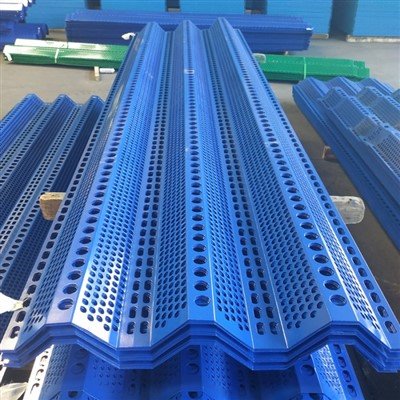
Common windbreak and dust suppression net support structures include cantilever column type, steel frame type, and space frame type. The support structure accounts for a large proportion of the initial investment in windbreak and dust suppression net projects. Therefore, in practical projects, it is necessary to compare and optimize several common windbreak and dust suppression net support structures to determine the most economical and reasonable structural form to reduce project investment.
Optimization of Cantilever Column Structure:
Typical support structure for windbreak and dust suppression nets. In practical projects, to facilitate the installation of mesh materials, the cantilever columns of the support structure are often circular tubes with a uniform outer diameter. Under horizontal wind loads, the internal forces at the bottom section of the cantilever column control the cross-sectional dimensions of the column; the strength margin of the cantilever column cross-section increases with height.
Optimization of Steel Structure: Considering the stress characteristics of windbreak and dust suppression nets with steel frame support structures, the support structure is often a triangular steel frame. To reduce column bending moments and structural lateral displacement caused by wind loads, the triangular steel frame is equipped with horizontal and diagonal braces. The main parameters affecting the internal structure of the steel frame include the base width and the spacing of the horizontal braces, which primarily control the axial force of the columns and the bending moment of the front columns, respectively.
Determining the Base Width of the Steel Frame:
For a steel frame with a defined height and load conditions, the horizontal brace spacing is initially selected based on experience and kept constant. The base width is then gradually adjusted, and the steel consumption of the support structure is calculated.
Determining the Spacing of the Horizontal Braces:
After determining the base width of the steel frame, the horizontal brace spacing can be more easily selected. A larger horizontal brace spacing results in a larger design bending moment for the front columns, significantly increasing the steel consumption of the columns. Conversely, a smaller horizontal brace spacing results in a smaller design bending moment for the front columns, but increases the number of braces and the workload of fabricating the steel frame.
Cross-Section Estimation:
The most unfavorably stressed member in the entire steel frame structure is the bottom section of the front columns. The cross-section verification of this compression-bending member is primarily controlled by stability considerations.
Cross-Section Estimation:
Comparison of Support Structure Types: Commonly used support structures for windbreak and dust suppression netting projects include cantilever columns, steel frames, and space frames. A comprehensive comparison needs to be made based on the characteristics of each type of structure and factors such as steel consumption. Compared to cantilever columns, steel frame structures save more steel and are simpler to design and construct than space frame structures. Therefore, steel frame structures are a more economical and convenient support structure for windbreak and dust suppression netting and are worth recommending in engineering applications.