Windbreak Wall - Perforated Steel Dust Control Panels & Posts | Chengrun
Perforated windbreak wall panels and steel support posts, fabricated together in Anping, Hebei. Single to five-peak profiles, 30–40% open area, panels up to 8 m. Free design drawings and samples.
We make both halves of the system — the perforated panel and the steel post — under one roof in Anping, Hebei. Coil is uncoiled, punched, formed, welded and coated on our own automated lines, so the 30–40% open area you specify on the panel and the wind load you specify on the post are solved by the same engineering team, not split between two suppliers. We ship full containers to mining, port and power projects across Southeast Asia, the Middle East, Africa, Europe, the Americas and Central Asia.
-
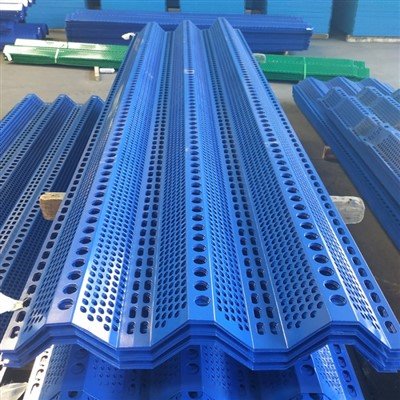
![Steel Windbreak Fence]() Steel Windbreak Fence• Steel Windbreak Fence comes in single, double, triple, and five-peak profiles. Depending on the profile, formed width is 200-950 mm; panel length is 1-8 m.
• Available materials are... -
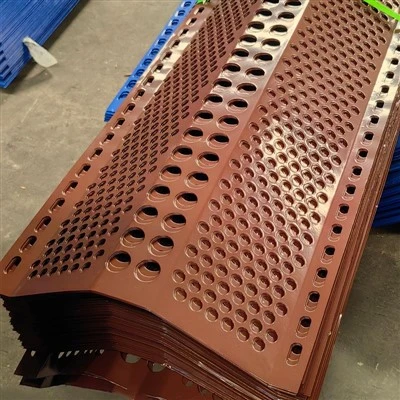
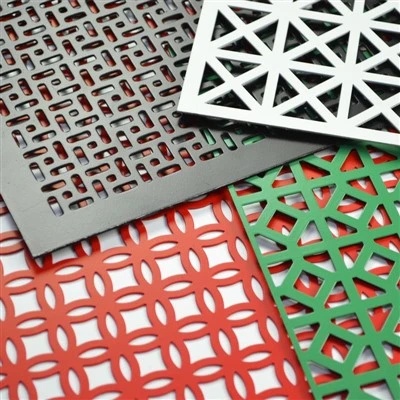
![Custom Perforated Dust Screen]() Custom Perforated Dust Screen• Custom Perforated Dust Screen: Round, slot, square, or project-specific perforations. It covers custom panel width and length to drawings.
• Galvanized steel, stainless steel, aluminum,... -
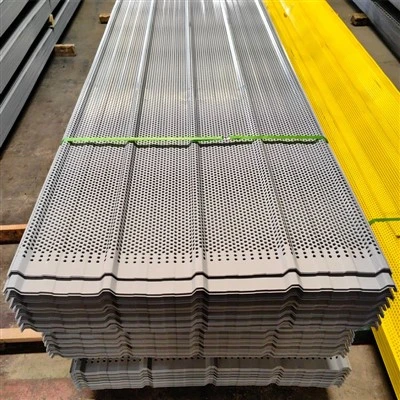
![Single Peak Windbreak Panel]() Single Peak Windbreak Panel• Single Peak Windbreak Panel: One corrugated peak with perforated faces. Main dimensions are 200-450 mm formed width; 1-8 m length.
• Galvanized or color-coated steel sheet. Thickness or... -
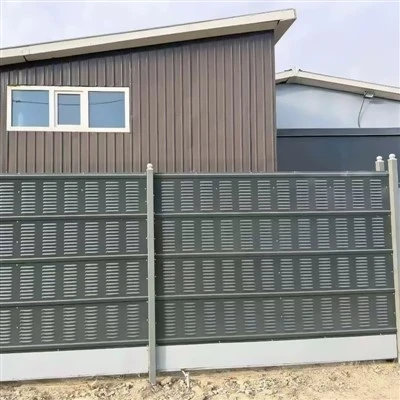
![Steel Louver Fence]() Steel Louver Fence• Steel Louver Fence: Inclined louver blades in modular panels. Size: panel sizes made to elevation drawings.
• Galvanized steel or coated steel louvers with steel framing. Thickness or...


What Is a Windbreak Wall?
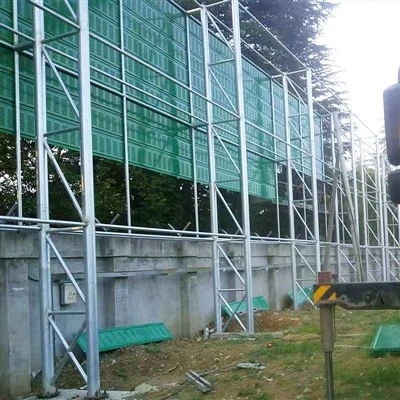
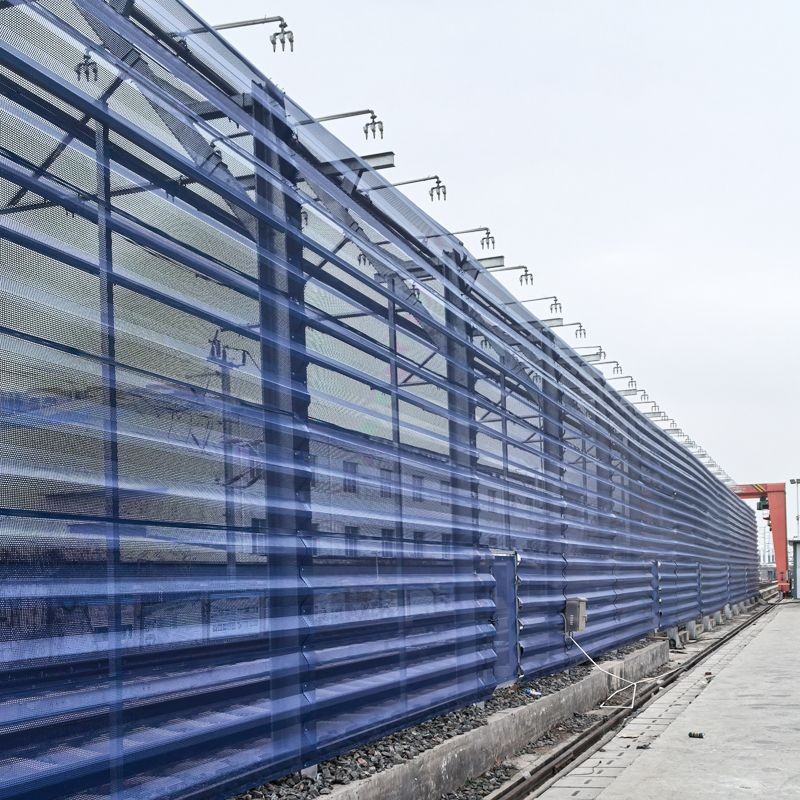
A windbreak wall — also sold as a dust control fence or windbreak fence — is a free-standing perforated steel barrier built around open stockpiles, ports and industrial yards to slow the wind before it reaches the material. Unlike a solid wall, the panel is punched with a controlled open area, so part of the air passes through and the rest is broken into smaller, slower eddies on the leeward side. Velocity at the pile drops below the threshold that lifts dust, and fugitive particulate stays where it belongs.
The system has two structural halves: the perforated panel, which does the aerodynamic work, and the steel support post, which carries the wind load into the foundation. A wall is only as good as the weaker half — a well-profiled panel on under-sized posts will deflect or fail in the first design storm.
How a Perforated Windbreak Wall Reduces Wind Speed
Three things happen when air meets the panel, and all three depend on the open area.
The stream is split, not stopped
A solid wall stops the wind and creates a high-pressure zone in front of it plus a violent recirculating eddy behind it — which is exactly where stockpile dust gets lifted. A perforated panel lets a controlled fraction of the air through, so peak pressure on the structure falls and the leeward flow becomes a series of small, low-energy eddies instead of one large vortex.
Open area is tuned, not maximised
The working range is 30–40%. Below that, the panel behaves too much like a solid wall and the wind load on the posts climbs; above it, too much air passes straight through and the barrier stops doing useful work. Hole size, pitch, pattern and unperforated margins are all set on the approved panel layout.
The profile adds stiffness
Panels are pressed into single, double, triple or five-peak corrugations. The corrugation is structural, not decorative: it raises the section modulus so a 0.5–1.6 mm sheet can span between posts without oil-canning or flutter under gust loading.
Two Halves of the System: Panels and Posts
The panel is the working face. Perforated, corrugated sheet in single-peak, double, triple and five-peak profiles — see the Steel Windbreak Fencerange for the full profile family — formed width 200–950 mm, panel length 1–8 m, in hot-dip galvanized steel, Galfan, stainless 304/316, color-coated PPGI or aluminium.
The post is the structure. H-section, rectangular hollow section, truss or fabricated built-up column in Q235B or Q355B, with height and spacing calculated from wall height, site wind load, panel weight and bracing arrangement — walls of 20 m+ are built this way. Posts are supplied as a matched product line: see Windbreak Steel Support Posts.
Because both are fabricated in the same plant, the panel's open area and the post's section are matched on one drawing. That is the difference between buying a system and buying two components that were each sized by someone else.
Panel Profiles and Formed Widths
|
Profile |
Sheet thickness |
Formed width |
Panel length |
Typical use |
|
Single-peak |
0.5–1.6 mm |
200–450 mm |
1–8 m |
Narrow modules, modular retrofits, tight footprints |
|
Double-peak |
0.5–1.6 mm |
500–900 mm |
1–8 m |
Mid-span sections, smaller yards |
|
Triple-peak |
0.5–1.6 mm |
810–950 mm |
1–8 m |
Wide post spans, fewer overlapping joints |
|
Five-peak |
0.5–1.6 mm |
900 / 950 mm |
1–8 m |
Large mining and port walls, maximum rigidity per panel |
Wider panels mean fewer joints to seal and fewer fixing points per square metre, which is why triple and five-peak panels usually win on large walls even though the sheet cost per square metre is the same. Narrow panels stay useful where the wall turns, steps in height, or has to be lifted by hand.
Custom perforated screens are also available where the perforation pattern has to follow your own drawing — round, slot, square or project-specific holes, set out to reach a defined open area. Where airflow must be controlled without a fully perforated face — conveyor transfer houses, plant boundaries, equipment enclosures — the Steel Louver Fence uses inclined louver blades in modular panels instead.
Technical Specification
|
Item |
Available specification |
|
Product |
Perforated windbreak wall panel / dust control fence |
|
Profile |
Single-peak, double-peak, triple-peak, five-peak |
|
Sheet thickness |
0.5–5 mm (custom) |
|
Formed width |
200–950 mm by profile |
|
Panel length |
1–8 m |
|
Open area / porosity |
30–40% |
|
Perforation |
Round, slot, square or project-specific; layout set on approved drawing |
|
Base material |
Hot-dip galvanized steel; Galfan / Aluzinc (55% Al-Zn); stainless 304/316; color-coated PPGI; aluminium alloy |
|
Finish |
Hot-dip galvanizing, electrostatic powder coating, PVC dipping, or combined treatment |
|
Color |
Blue, green, gray, white, red, orange; RAL or Pantone on request |
|
Support post |
H-section, rectangular tube, truss or fabricated column; Q235B / Q355B |
|
Post height |
Up to 20 m+ (project-specific) |
|
Post spacing |
Calculated from wall height, wind load, panel weight and bracing |
|
Foundation |
Embedded post, flange-and-anchor-bolt base, or complete braced frame |
|
Service life |
15–20 years maintenance-free outdoors (HDG + powder coating system) |
Where Windbreak Walls Are Used
Mining and ore stockpiles
open-cast coal mines, iron ore and aggregate yards. Panels cut wind velocity at the source, limiting material loss and fugitive PM10.
01
Bulk ports and logistics terminals
commercial docks, maritime ports and railway freight yards. Heavy-wind-load barriers that hold up in corrosive coastal air and stop cargo blowing into the water.
02
Construction sites and waste management
site boundaries, road infrastructure projects and landfills; modular panels trap transient dust and block debris during heavy operations.
03
Arid and wind-sand regions
highway and railway corridors where the wall works as a sand trap, reducing accumulation on track and carriageway.
04
Industrial plants
steelworks, cement plants and chemical facilities, forming an aerodynamic boundary around open raw-material storage to meet local environmental requirements.
05
Also specified for: coal yards, port bulk-storage areas, railway freight yards, construction-material yards, power station stockpiles, industrial dust-control zones and sand-blocking corridors.
How to Specify a Windbreak Wall
Five inputs decide everything else. Send them and the drawing follows.
1. Wall height and pile height together. A wall that is too short lets air re-attach and drop dust back onto the pile; too tall and you pay for steel you do not need. Both are read off the same wind study.
2. Local wind — average and maximum. Design wind speed drives the post section, the foundation and the bracing. Coastal and open sites are not the same structure as sheltered inland yards.
3. Post spacing. Set by wall height, wind pressure, panel weight, rail layout and foundation capacity — not by what is convenient to lift.
4. Profile. Single and double-peak for narrow modules, tight footprints and modular retrofits. Triple and five-peak where post spans are wide: higher rigidity per panel and fewer overlapping joints, which is what makes them the economical choice on large mining and port walls.
5. Foundation. Embedded post, flange-and-anchor-bolt base, or braced frame — decided by what the existing concrete and anchor design can actually carry.
What to send for a quotation: wall length and height, preferred profile, site exposure, post spacing, gate and corner locations, and any foundation drawing you already have.
Made to Your Drawing — OEM and ODM
This is not a catalogue product. Panels and posts are fabricated against your elevation and structural drawings, and the process is set up to make that painless:
Complimentary design planning and engineering drawings before order, with our technical team adapting panel, post and finish to the site
Sample panel and first-article approval before a batch is released — essential where the perforation layout or folded profile is non-standard
Custom perforation from CAD data, checked first against minimum bridges, edge distances and tooling limits
Custom sheet thickness, panel length to 8 m, custom colours to RAL or Pantone
On-site factory inspection tours for buyers and engineering contractors
Full-process production tracking with multi-stage inspection, export packaging and container loading plans
Production runs on dedicated equipment for this product family: 3 fully automated CNC punching lines, 5 CNC perforating presses, 2 hot-dip galvanizing lines and 2 automated electrostatic powder coating lines, with laser cutting and laser welding for custom work.
Send the drawing. If something on it cannot be pressed or punched, you will hear it before production rather than after delivery.


Before, During and After the Order
Pre-sales — custom design planning, engineering drawings, samples, and factory inspection tours. Technical team adapts panels and posts to stockpile dust control, port storage yards and industrial plant boundaries.
In-sales — full-process production tracking, multi-stage quality inspection, export-grade packaging, precise container loading and punctual shipping.
After-sales — installation technical guidance, detailed installation manuals, structural engineering layout guidance, proactive warranty maintenance and rapid-response troubleshooting.
We supply consistent, modular panels and standard structural members so a local crew can assemble the wall without specialist tooling.
Frequently Asked Questions
FAQ
Q: What perforation rate should a windbreak wall have?
A: 30–40%. That is the aerodynamic working range: it breaks high-velocity linear wind into low-velocity turbulence and relieves pressure on the structure. Too high or too low and you will not reach the stated dust suppression efficiency, however good the coating is.
Q: Should I choose single-peak, triple-peak or five-peak panels?
A: It follows post spacing and wind load. Single and double-peak are flexible and suit narrow spans, modular retrofits and smaller footprints. Triple and five-peak give much higher rigidity and wider coverage per panel, cutting the number of overlapping joints — usually the most economical choice on large mining and port walls with wide post spans.
Q: How long will the wall last outdoors?
A: 15–20 years maintenance-free with the hot-dip galvanizing plus electrostatic powder coating system, in conditions from UV exposure to coastal salt spray and industrial acid rain. Stainless 304/316 is specified where the environment is more aggressive than a coating system can handle.
Q: What is the sheet thickness?
A: Corrugated windbreak panels run 0.5–1.6 mm. Custom perforated screens and louver panels run 0.5–5 mm. The exact gauge is confirmed against your structural drawing, because it interacts with post spacing and wind load.
Q: Can you fabricate to our own drawings?
A: Yes — panel profile, sheet thickness, perforation pattern, panel length up to 8 m, colour to RAL or Pantone, and post section in Q235B or Q355B, all against your elevation and structural drawings. Custom perforation is cut from CAD data after checking minimum bridges, edge distances and tooling limits.
Q: What do you need from me to quote?
A: Wall length and height, preferred profile, site exposure, post spacing, gate and corner locations, and any foundation drawing you have. A wind load figure shortens the process considerably.
Q: Can one wall use several colours?
A: Yes. Different wall zones can carry different colours when they are agreed before production — useful where a long wall passes several site boundaries.
Q: Do you supply the foundation and bracing?
A: Foundation options are embedded post, flange-and-anchor-bolt base, or a complete braced frame. Braces and rails are supplied when they are part of the confirmed steel-frame schedule. Flange mounting is used only where the concrete and anchor design can carry the calculated loads.
Q: How is the wall shipped?
A: Full container load (FCL) is our standard mode for these projects, with export packaging and a loading plan for the panel and post schedule. Sections are marked for direction and connection where a wall ships in parts.
Q: Do you support installation?
A: We provide installation manuals, structural engineering layout guidance and technical support so your local crew can assemble the wall. Panels are modular with consistent dimensions and a standard overlapping profile, which is what makes rapid site assembly possible.
Get a Drawing-Based Quote
Send your elevation drawing or the five specification inputs above — wall height, site wind, post spacing preference, profile and foundation type - and our engineering team will return a panel and post layout with a quotation.
With abundant experience, we are one of the most professional windbreak wall manufacturers and suppliers in China. Please feel free to buy premium windbreak wall for sale here from our factory. All customized metal products are with high quality and competitive price.
Corrugated Steel Windbreak Panels, Metal Dust Control Fencing, Steel Windbreak FencePopular Products