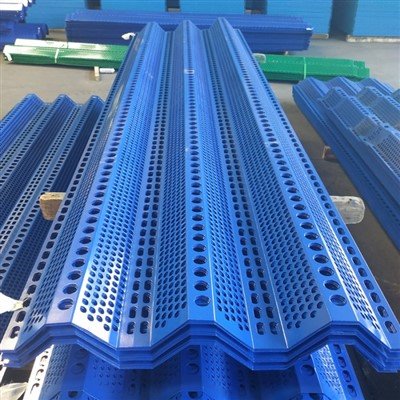
Dust suppression nets reduce dust generation by lowering the wind speed of incoming air, minimizing the loss of kinetic energy, avoiding significant eddies, and reducing turbulence.
Porosity is the most significant factor affecting the efficiency of dust suppression nets. The wind field structure and surface shear force characteristics around material piles differ significantly between low-porosity and high-porosity nets. Studies show that a porosity of 0.25 is the turning point where the flow field around the material pile transitions from vortex flow to adhering flow as the dominant force. At this point, the surface shear force of the material pile is minimal, only 22.5% of that without netting, resulting in superior dust suppression.
The installation method of windbreak nets needs to be designed according to the size and shape of the stockpile and local meteorological conditions such as wind direction and frequency. Common types include upwind placement, four-sided placement, and three-sided placement. Windbreak nets should ideally be installed at a distance of 2 to 3 times the height of the stockpile. For large-scale windbreaks, such as those with a single-sided length of thousands of meters and a height of over ten meters, further research is needed on their structural safety issues, including dynamic loads, drag coefficients, and vibration.