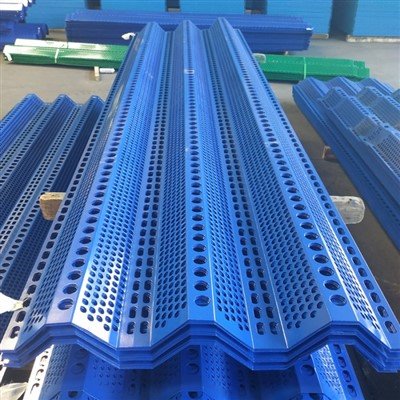
The technology of windbreak and dust suppression nets for coal yards was researched and applied earlier abroad. Countries such as Japan, the United States, the United Kingdom, and Australia have all conducted in-depth research and application of windbreak and dust suppression technologies. More than 20 years ago, Japan already applied windbreak nets to control dust pollution in open-air coal yards at ports. Research on windbreak and dust suppression technology in my country started later. In the mid-1980s, the Fluid Mechanics Department of Wuhan University of Hydraulic Engineering conducted experiments on the relevant structural parameters of windbreak nets using environmental wind tunnel tests combined with the Shanghai Zhujia Wharf coal yard.
In the early 1990s, the Water Transport Research Institute of the Ministry of Transport collaborated with the Environmental Aerodynamics Research Laboratory of the Environmental Science Center of Peking University to conduct a series of studies on the dust suppression mechanism, main structural parameters, and dust reduction effect of windbreak nets in conjunction with the windbreak net installation project at the Qinhuangdao Wharf coal yard. In recent years, some research has also been carried out on the multi-layer structure of windbreak nets and the air turbulence structure behind the nets. Domestic research mainly focuses on technical verification based on the needs of engineering feasibility studies, gradually improving and perfecting the technology through actual engineering operating parameters.
The application scope of dust control netting in coal yards has expanded from coal storage yards of coal mines, coking plants, and power plants to open-air material yards of port terminals, steel, building materials, and cement enterprises, as well as fields such as crop wind protection and road dust control. Single-layer windbreak and dust suppression walls can achieve a dust suppression effect of 65-85%, while double-layer windbreak and dust suppression walls can achieve an effect of over 95%.