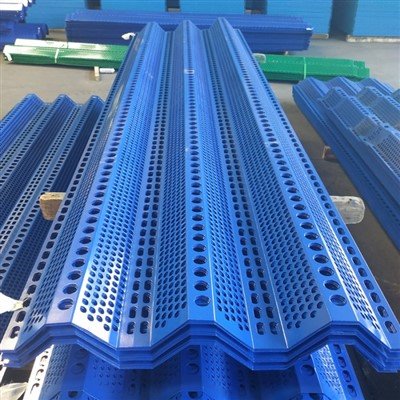
Perforated aluminum sheets are a commonly used metal screen material, widely applied in filtration, protection, and decoration. Their specifications directly affect product performance and applicability. Below are common specifications and selection points.
Aperture and Hole Type:
Apertures typically range from 0.5mm to 50mm, with common shapes including round, square, and oblong. Round holes are mostly used for filtration and ventilation, square holes balance strength and light transmission, while oblong holes are advantageous for screening materials. For example, air conditioning filters often use 5mm diameter round holes, while protective mesh often uses 10mm x 5mm oblong holes.
Sheet Thickness and Material:
Aluminum sheet thickness is generally 0.2mm-5mm. Greater thickness increases strength but also weight. Common materials are 1060 pure aluminum (soft state) and 3003 aluminum alloy (semi-hard state). The former is suitable for stamping complex shapes, while the latter is used in load-bearing applications. For example, 1.5mm thick 3003 aluminum sheets are commonly used in architectural curtain wall decoration.
Plate Thickness and Material: Mesh Density
Pore density is expressed in "mesh count" or "pore spacing," with higher mesh counts indicating smaller pore sizes. Industrial filtration commonly uses 10-200 mesh, corresponding to pore spacings of 0.5mm-10mm; architectural and decorative mesh is mostly 5-10 mesh, with pore spacings of 15mm-50mm. For example, automotive muffler filters commonly use 80 mesh (0.2mm pore size).
Size and Processing Method
Standard sizes are 1m×2m and 1.22m×2.44m, but custom lengths and widths are available. Processing techniques include laser punching (0.1mm precision), mechanical stamping (mass production), and etching (fine micropores). Precision instrument heat sinks often use laser-cut 1mm×1mm mesh.
When selecting perforated aluminum sheet mesh, the pore size, thickness, and material parameters must be determined based on actual needs. It is recommended to provide specific application scenarios to obtain more accurate specification recommendations.