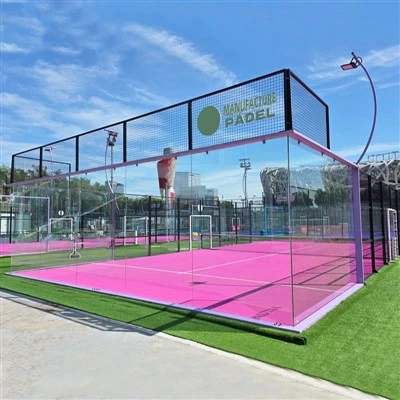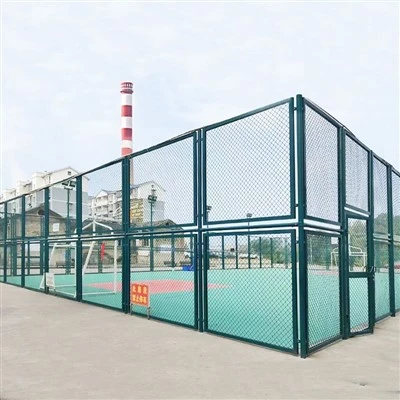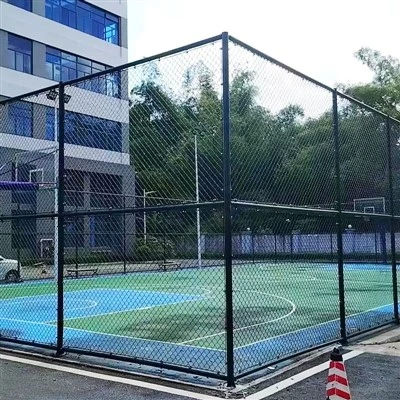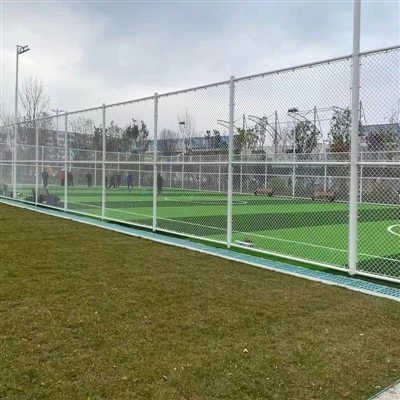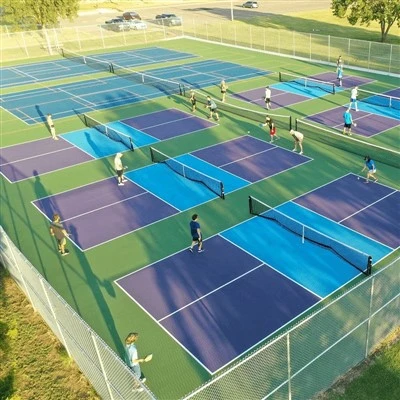


Tennis court fencing may use welded mesh or woven chain-link mesh. Typical height is 3-4 m, with 50 × 50 mm or 45 × 45 mm openings.
Galvanized steel posts, corner supports, rails, and gates are paired with 3.0-4.5 mm wire. Overall length follows the measured court perimeter and access layout.
Description
A tennis court fence keeps balls inside the playing area without making the court feel boxed in. Welded mesh gives a straighter, more rigid line, while chain-link fabric has more give and can follow an uneven boundary. With tennis court fencing, height and mesh opening are only part of the decision. Light poles, gate swings, maintenance access, and ground level can all affect post positions. A two-court block may share an internal divider; a single court usually needs a simpler perimeter.
-
3 +Fully automated CNC punching lines
-
5 +CNC perforating presses


Installation Notes
Before the first post is set, walk the perimeter with the court plan. Mark corners, player entrances, service access, lighting columns, and shared dividers. On a tennis court fencing project, this shows where standard bays will work and where a shorter closing section is needed. It can also prevent a gate opening into a bench area or a post landing too close to a light base.
Product Parameters
|
Item |
Available specification |
|
Construction |
Welded mesh or woven chain-link mesh |
|
Typical height |
3-4 m |
|
Mesh opening |
50 × 50 mm or 45 × 45 mm |
|
Framework |
Galvanized steel posts, corner supports, rails, and gates |
|
Overall length |
Based on the measured court perimeter and access layout |
Applications
- Professional tennis courts
- School and university courts
- Community sports areas
- Private clubs
-
Multi-court developments
FAQ
Q: Which mesh opening is commonly used?
A: The supplied options are 50 × 50 mm and 45 × 45 mm. The final choice should suit the approved frame layout and court use.
Q: Can the fence follow a sloping boundary?
A: Yes. Posts can step with the grade, but each bay should be checked so the bottom gap stays practical and the mesh keeps its shape.
Q: What information helps before ordering?
A: For tennis court fencing, send the court perimeter, preferred height, gate positions, light-column locations, and known level changes. A marked-up plan is usually enough to begin.
Hot Tags: tennis court fencing, China tennis court fencing manufacturers, suppliers, factory, backyard basketball fence, basketball court chain link fence, court fence, football stadium fences, tennis court chain link fencing, tennis court perimeter fencing